A quick story-driven piece about stepping away on purpose, even before you “have to.” It’s a simple lesson about pacing, identity, and not waiting for a perfect moment to reset.
John Cleese and What Happens When Divorce Derails Retirement /
A story-led piece about how a major life change can scramble long-term plans. I focus on the human side first, then the practical takeaway: how to regroup when the plan you had stops being the plan.
Summer Staycations That Won’t Scorch Your Wallet /
A practical list of staycation ideas - I share what’s worth doing, what to plan ahead for, and how to avoid the “we spent more than we meant to” trap.
5 Books to Redefine Your Retirement /
A short list of books that reframe retirement as identity and meaning, not just money. Each pick comes with a clear “why this matters” takeaway so readers can choose fast.
Why Skip-Gen Travel Is the New Retirement Trend /
Skip-gen travel is when grandparents travel with grandkids, sometimes without the parents. This piece explains why it’s growing, what it looks like in real life, and how families can plan it without stress.
Understanding Chinese Storytelling Series - Shadow 影 /
Shadow 影
For the Chinese version (translated by Nicole Zhang 妮可张) 中文版 Click here
To download the beat sheet of values Click here
This is not a review of the film but a detailed scene-by-scene story analysis. By understanding how writers from China assemble their stories we can gain a better insight into the thinking process.
This is the first story analysis in a series called Understanding Chinese Storytelling. I wanted to start off with one of the more advanced films but in the future the films will be a lot lighter. This is not a science – it’s all my opinion. In storytelling writers deal in abstracts every day and this is only my interpretation. Another writer might see things in a completely different way and oddly enough – both could be correct.
Throughout this breakdown I’ll be assigning a value of + (positive) – (negative) ++ (double positive) or - - (double negative) in the plot summaries and at the end of every scene. This is important for writers because a film is essentially a back-and-forth exchange of values.
It’s also useful because it’ll tell us what kind of story we’re dealing with. For example, if a 2nd act climax ends with a - - then we know the climax will be ++, which is what a comedy is. A tragedy usually has a 2nd act climax of ++ and a 3rd act climax of - -.
Before we get into the story let’s talk about the title 影 or shadow. The shadow, in relation to mythology, is a type of archetype that’s traditionally assigned to the role of a villain or antagonist.
To quote Christopher Vogler’s “The Writer’s Journey” the shadow represents “the energy of the dark side. Shadows can be all the things we don’t like about ourselves, all the dark secrets we can’t admit, even to ourselves.” So what does this mean psychologically? Volger goes on to say “The shadow can represent the power of repressed feelings. It can be the part of ourselves we are always wrestling with our old fears and bad habits that if we don’t deal with can be destructive.”
This is important because as we’ll see this is the story of two characters that start off in the darkness and one confronts the darkness while the other succumbs to it. The main character, the shadow, starts the film with a negative and his arc is about embracing the light to the positive or in other terms starting as a “fractured human” to “becoming a whole human”. On the other hand, Zi Yu, we’ll see, begins the story in a negative and his arc ends in a double negative since he chooses to embrace the darkness and in the end, he succumbs to jealousy and hatred to the point where he’s punished for it. This film is about what are the consequences when we embrace the darkness vs what happens when we embrace the light. The image system of the film – the yin and yang sign will be scattered throughout the film to remind the audience of this central theme. So, let’s get into it.
Writers: Li Wei and Zhang Yimou
Characters
Commander Zi Yu – The respected warrior who controls things behind the scenes. He wants to invade Jingzhou city and become King but that drives him mad.
Jing Zhou – referred to as the “shadow” of Zi Yu. He wants to serve Zi Yu but he needs to become a whole person – something bigger than who he is at the beginning of the film.
King of Pei – a drunkard and womanizer but in reality, he’s smart and calculating. He wants to maintain peace in order to hold onto his throne but reveals himself as a coward in the process.
Xiao Ai – Zi Yu’s wife. She misses who her husband used to be but finds it in the shadow. She wants to be obedient to Zi Yu but she needs to let go of him and love the shadow.
Princess Qing Ping – The King’s sister. She wants to keep her honor but needs to become her own woman.
Yang Cang – Infamous hero of the Yan kingdom.
Yang Ping – Yang Can’s son whose arrogance will eventually bring him down.
Lu – The King’s faithful servant.
Why did I choose this film? It’s an overlooked masterpiece that has an advanced storytelling design. I watched this in downtown Beijing the weekend it came out and sadly I was all alone in the theater. After watching it my mind was blown – the writing, the directing, and the cinematography were all first class. Why was no one else appreciating this film?
The story is built upon layers and as the film progresses the layers are used to trick the audience into thinking one thing when the reality is the opposite. It’s a high-level game of chess. Each character has an agenda and holds a secret in their heart but eventually they’ll be forced into situations where the secret will have to be revealed.
But most importantly it’s a story about becoming who we were truly meant to be. Isn’t that what all great characters have to deal with?
Opening titles – 1:29 – 1:50: What are we dealing with here?
We’re going to be diving into the world of kings and nobles who face constant wars and internal power struggles. We’re told that kings and nobles in this world employ a loyal double called a “shadow”, who will risk their lives in any assassination attempts. They’re the unsung heroes who’ve been left out of the history books.
Scene 1: 1:50 – 2:10 - Plot summary: The next title introduces Xiao Ai, the wife of the great Commander Zi Yu of the Pei Kingdom, who peers through the door frightened out of her mind. We don’t see what she sees but we’re told she’s going to have to make the most difficult decision of her life.
Comments - Why did the writers open with this scene? This is a standard “hook” scene that pulls the audience in to create a sense of mystery. What is she seeing that’s so frightening? What is this difficult “decision” she’ll have to make? The writers are making us curious to know more. All Hollywood films begin with its own hook scene so this is pretty standard.
Value: I’ll be assigning a neutral value to this scene because we’re not sure what the scene means within the whole film.
Scene 2: 2:10 – 3:28 - Plot summary: Lu, the King’s servant, approaches the King who’s drunk and is playing games with a group of women. Lu tells the king that Zi Yu visited Jing city to give Yang Cang a birthday greeting. The King gets pissed at why he wasn’t informed before. -
Commander Zi Yu arrives back to the Pei kingdom.
Comments - Already in a few seconds we know so much about the King – he’s a drunkard who likes to idly waste time with women. Isn’t that the curse of a King? They have all the power in the world but they rarely leave the palace and don’t know what to do with their time. The writers are giving us the king’s psychological makeup just with a few small details.
However, this is a trick the writers will be playing on the audience throughout the film. Show us one side of the character when in fact he/she is not what they appear to be.
Value: - I’m assigning this scene a negative value because Zi Yu’s actions have disrupted the balance of the world. In the story, it’s considered a small change so it’s not the inciting incident yet because we don’t have enough information at how this decision changes the stakes.
Scene 3: 3:28 – 12:37 - Plot summary – Xiao Ai foretells the future to Qing Ping with dice and predicts Qian, the masculine origin of things shall rule the world and women don’t have a place in the court. Another prediction is the court will win the battle once the water rises after seven days of rain. ++
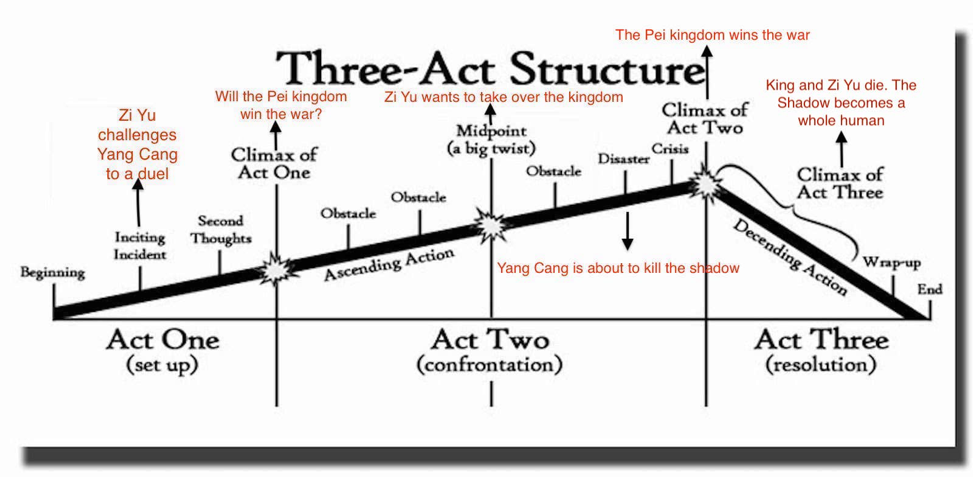
Right after the prediction is made Zi Yu enters (perfect timing) and disrupts the fortune after announcing he has challenged Yang Cang, the infamous warrior of the rival Yan kingdom, to a duel for a second time (the first time he lost). The Pei and Yan Kingdoms have lived in peace for the last 20 years after the Yan kingdom took the city of Jingzhou. – – (inciting incident)
Enraged that Zi Yu didn’t ask for his permission, the King is worried that a duel between both of the head commanders is a sign of war. The King asks Zi Yu what are the odds of winning and Zi Yu says he has a 30% chance. –
The King is at a loss for words since without the peace treaty they would have lost their kingdom a long time ago. Zi Yu knows the people in their kingdom want Jingzhou returned and he confronts the King by saying if Jingzhou isn’t returned to them the Pei kingdom will perish. Zi Yu says he went behind the King’s back by announcing his intentions to his enemies on behalf of the kingdom. –
Frustrated, the King drops the subject since he remembers Zi Yu is responsible for getting him the throne. +
As a form of subtle punishment the King orders Zi Yu and his wife to play the 古箏 guzheng (zither) but the wife has vowed not to play until the city of Jingzhou is in their possession. –
She vowed that if she were to play she would cut off her finger but the King says it’s nonsense and orders them to play. After Xiao Ai plays, she takes out a dagger to cut her finger off but Zi Yu stops her and cuts off his own hair instead as a form of self-sacrifice. +
After Zi Yu and his wife leave, the King tells Lu he was just trying to deflate Zi Yu’s arrogance. He then arranges for Qing Ping, his sister, to marry Yang Cang’s son, Yang Ping. -
What’s his motivation? It’s a message to Yang Cang that Zi Yu isn’t a representative of his beliefs and that he doesn’t want to take the city of Jingzhou back by starting a war. All he wants is peace. +
Comments: Take a breath of fresh air! At over 9 minutes this long yet masterful scene gives us an indication of what the world looks like and what the main conflicts are.
In the opening beat of the scene, the writers have used a Shakespearian device similar to Macbeth (3 witches predict Macbeth will become king). We’re interested to know if the prophecy will come true even when the King doesn’t want to start a war. How’s that going to happen?
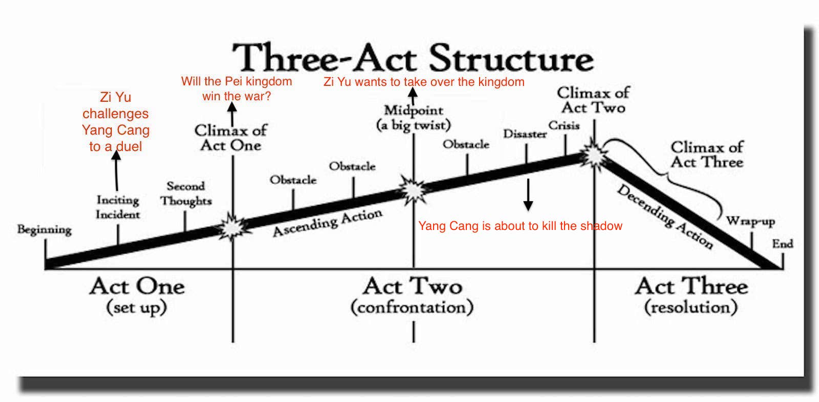
Now the main dramatic question of the film: Will the Pei kingdom win the war? is introduced here. This is usually a question posed at the end of act 1 (around 30mins into the film) but it’s not solidified enough in this scene because it’s not motivated by a character. We’ll see it solidified in scene 7.
Another very similar Shakespearian device is when Zi Yu enters the room just after the prophecy was made. This little clue foreshadows that Zi Yu will be the one to disrupt the kings balance. This incidentally is the inciting incident of the film (the moment that disrupts the balance of the everyday world). Zi Yu’s decision to fight Yang Cang will throw the kingdoms peace treaty into chaos.
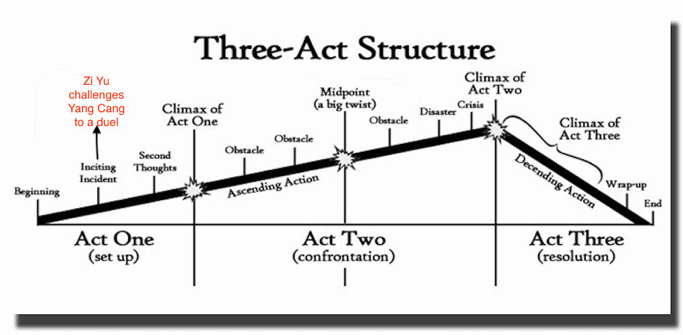
So far, the writers have designed the structure very similar to a Hollywood style film.
This film, broken down, is simply a clash of destinies. Zi Yu has his own destiny – he wants to restore his honor by dueling Yang Cang but it’s in conflict of the destiny of the King who just wants peace. Can they compromise or will their destinies bring the kingdom down? This is what the film appears to be about but as the layers are peeled, we’ll realize there’s more than meets the eye.
Little pockets of information are interspersed throughout the scene that can be so revelatory of character and they happen so subtly that some people won’t recognize it. For example, when Zi Yu enters the room for the first time, Qing Ping says “Our lone hero has returned” and the King scolds her for a second. In one line, it can be interpreted that Qing Ping looks up to Zi Yu when she should be looking up to the King. Is Zi Yu a more respectable character than her own brother? Is the King jealous of his own sister? Little bits of this type of information gives us subtle clues into the lives of these characters.
We know that Zi Yu is an honorable person but he knows he’s able to bend the rules to get what he wants. After telling the King he went behind his back and announced his intention to Yan’s army, he immediately asks for punishment. He’s a classic rebel character who defies authority (think Spartacus or the Matrix or any action film really) because he’s respected greatly in the army and can get away with it.
We also gain more insight into who these characters are. The King is caught between a rock and a hard place. Zi Yu is responsible for getting the king onto the throne and yet the king needs to punish him. Already the writers have created a dilemma for the King. That’s all a great movie does – constantly put a main character in a bind and that way they will find out who they really are. They say stress and pressure makes beautiful diamonds.
The final moment of character revelation for the king is the start of the Qing Ping and Yang Ping subplot. He offers his sister up for marriage – like she’s a piece of meat – in his game of chess to keep his power. Even though he has good intentions we see how cold hearted he really is in times of pressure.
Rarely can a scene hold for 9 minutes long. Quentin Tarantino once commented that suspense in a scene is like a rubber band – stretch it too much and it can snap, don’t stretch it enough and it becomes limp. How can the writers get away with it? They introduce different topics and characters and build the tension - almost like a back and forth dance, which we’ll see is a running image system in the film.
It’s interesting to note not just the length of the scenes but how many scenes there are – 22. That’s much less than the 40-60 or even 80+ scenes in a traditional Hollywood film. The writers of the film stretch these scenes out to the max and they manage to pull it off. A far cry from the films today, where a scene can be 20-30 seconds long to fulfill our short attention spans. The writers are bold enough to go back to the roots of Asian cinema to the likes of Yasujiro Ozu and Kenji Mizoguchi.
Value: + This scene is filled with more negative than positive but I’m going to say it ends on a positive because the King is now strategizing through compromise. He offers his sister’s hand in marriage as a sacrifice to not start a war so things are looking better.
Scene 4: 12:37 – 16:24 – Plot summary: Xiao Ai enters a hidden cave area within the court where we are introduced to the real Zi Yu and his shadow. Zi Yu cuts a fresh wound into his shadow in order to make it look like his old injury that he received from Yang Cang. –
While in extreme pain, the shadow confesses that when he was eight years old he passed out from hunger and Zi Yu’s uncle came and saved him. Since then he’s been in the court for 20 years and endured a lot of violence, but he’s grateful for having lived in the court. +
Zi Yu tells the shadow that if he kills Yang Cang he will let him go. ++
Comments: For the first time, we notice that the Zi Yu we saw in previous scenes isn’t the real Zi Yu. Again, we’re being tricked. Cool, right?
The writers are using some dramatic irony here as the audience is let in on a secret that only Zi Yu, the shadow and Xiao Ai know. This makes the audience an active participant in the story. The best writers, no matter from China or Hollywood, have been using this tool to empathize with the characters since the dawn of storytelling.
What’s unusual is that in the first 20-30 minutes of this film the audience isn’t 100% sure what the story is about and who’s story it is. Writing this way is a bit of a gamble. Some people might not have the patience to stick through the whole film but it’s a tool that if used in the right way can pay off if it’s within a certain story like “what you see isn’t what’s real” type of films.
Writers in Hollywood nowadays could never get away with this. Why? Because every screenwriting book in the west says you need to clearly state who the protagonist is right away. In Chinese storytelling, this isn’t necessarily so. Why? Because the storytelling concept of a game at which a trick is pulled on you is part of a long tradition.
We’re not 100% sure but this fourth scene gives us a better indication that the protagonist is probably going to be Zi Yu or his shadow.
What do we know about the shadow at this point?
1. That he’s a master actor. Not even the King can tell the difference and they have a rich history together. This is important because as the story progresses we’ll see how each character is playing a role of themselves (ie. a shadow of themselves)
2. He’s been living in the court since he was 8 (over 20 years). During this time, he was subject to massive amounts of violence from Zi Yu’s uncle. He’s a slave who’s been trained and molded to be Zi Yu. This is the shadows starting point. His character arc – he’s going to have to disconnect from playing Zi Yu and learn to become himself. How does one know to be oneself if you’ve been trained your whole life to be someone else?
3. After all this the shadow still tells Zi Yu he’s grateful for being his shadow. Would you be grateful if you were beaten for 20 years? Right now, it seems plausible but there’s got to be another reason. Later on, we’ll find out it’s because he’s been in love with Xiao Ai since he was a kid.
Let’s talk about the concept of Yin and Yang since it’s an idea that’s scattered throughout the film. The characteristics of Yin are an inward feminine energy that’s dark and negative. Yang is associated as being outward and masculine that’s bright and positive.
Why is this important? We’ll see the script is designed into two halves. The first half will focus mostly on Zi Yu while the second half will focus on his shadow. Two parts of one person. A short 3rd act will show the outcome of the clashing of these two opposites. This follows within the screenwriting idea of thesis, antithesis and synthesis.
Value: + If the shadow kills Yang Cang he’ll be free. That’s a good thing, right?
Scene 5 – 16:24 – 18:12 – Plot summary: Xiao Ai wraps some bandages around the shadow. Trying to interrupt them, Zi Yu coughs (everything is perfectly timed).
Zi Yu says the shadow has played his role well in the past year ever since Zi Yu was injured. He questions if Xiao Ai remembers who her husband really is?
Zi Yu tells the shadow he’s found his mother in Jingzhou. If the shadow beats Yang not only will he be free but he’ll be reunited with his mom. ++
Comments: In this scene, we see only a couple of sides of Zi Yu – that he’s protective of the ones he loves but also that he’s suspicious of the ones he loves. This is the yin and yang side to his character.
This is the first scene of the shadow and Xiao Ai love subplot and it’s a +. We know and they know and even Zi Yu knows something is going on romantically in this scene but no one ever says it. This is a brilliant use of subtext with emotions and is one of the highlights of Chinese cinema from the 90s that Zhang Yimou was a part of.
This scene also begins the shadow and mother subplot, which will contain only two scenes (the other scene is the first scene of act 3). The value is a ++.
After Zi Yu notices Xiao Ai and his shadow are getting closer by the day, an interesting moment happens when Zi Yu scolds Xiao Ai for not remembering who her real husband is. What exactly does he want her to remember him as? The confident and affable man who he used to be? Now he’s wounded and fragile – the exact opposite of who he was. Xiao Ai’s beginning to wake up to the idea that the shadow has the qualities the old Zi Yu had.
This shows the audience that Zi Yu still loves Xiao Ai and wants to do everything to keep her, which we can interpret as being his character flaw. He knows he’s not the same man as he once was but he wants to maintain the status quo and keep their relationship normal, similar to how the king wants to keep the status quo and even the shadow wants to regain the stability he once had with his mom.
We can conclude that all the male characters are trying to pursue or hold onto what they used to have and all the female characters want change. Isn’t this the opposite of what the definition of Yin and Yang is about? All the characters are out of balance. Is the writer saying that in order to become who we were destined to be we need to live in harmony with our energies? I’m only speculating. But right now, everything is going to be gravitating towards living in harmony.
Value: ++ I’m assigning the end of this scene a double positive value. If the shadow kills Yang Cang he will finally be reunited with his Mom, which is what he’s wanted his whole life.
Scene 6: 18:18 – 24:50 – Plot summary: A series of shots of Xiao Ai and the shadow’s everyday life. In public, they have to appear close but in private they sleep separately and need to keep their distance. Xiao Ai gives the shadow some ointment for his wound. +
It’s possible Zi Yu watches them from his cave. -
Xiao Ai tells the shadow he’s more than just a shadow, he’s an independent person. +
But the shadow says he has no idea who he is. -
In a moment of honesty, the shadow admits his biggest fear which is absolute darkness. He grabs hold of her but she pushes him away. -
Comments: These quick scenes give us an inner glimpse into how the shadow and Xiao Ai get through the day. Again, we see how the characters must behave when they’re in public and when they’re in private. One nice detail is that the shadow sleeps on the floor alone since this is what he believes he deserves. With this action, we see that he’s probably done this every day of his life since he sees himself as a slave who’s not a whole human. He knows he’s inferior to Xiao Ai and Zi Yu.
However, when Xiao Ai says that he’s more than just a shadow, the idea is planted in his mind for the first time that he’s separately distinct from Zi Yu. He’s a real person from Jingzhou who wants to go home and be with his Mom. It’s almost as if it’s the birth of his new identity (birth of an ego).
Seeing that Xiao Ai cares about him, the shadow admits in a moment of vulnerability that he’s scared of darkness and that’s why he sleeps with the light on (similar to a small child). There’s a moment where Xiao Ai rests her hand on his shoulder and caresses him in motherly fashion. Xiao Ai understands the shadows deepest fear and she also doesn’t want to be alone. Because Zi Yu’s personality has become more manipulative and darker while hiding out in his cave, the shadow’s moment of vulnerability is refreshing to her. She also wants more light in her life. This is a moment that deepens their relationship. When the shadow embraces her though, she pushes him away because she still serves her husband. The shadows vulnerability isn’t big enough to change her mind about her husband. It’ll take something much more (which will happen in scene 17).
However, the shadow is rightly aware that Zi Yu is dangling his Mom as a bargaining chip and still needs to serve out his purpose to defeat Yang Cang.
If we take a look at the Xiao Ai and shadow subplot we can see the value change:
Scene 4= -
Scene 5= + then –
This is to show how writers create scenes that end in up and down moments. That’s all a film really is – just a series of positives and negatives.
Value: - I’m going to assign it a negative since Xiao Ai pushed the shadow away.
Scene 7: 24:50 – 30:30: Plot summary - At a meeting in the Pei court Zi Yu admits declaring war on the Yan kingdom. – – (act 1 climax – the dramatic question is: Will the Pei kingdom win the war?)
He asks the King to behead him but instead the King strips him of his Commander status and makes him a commoner. -
The General tries to defend Zi Yu but the King’s not having it. -
The King offers an ointment to Zi Yu and wants him to strip. +
After discovering Zi Yu’s wound is fresh his interest is peaked. Why would he do this? -
In Zi Yu’s defense he says it’s a reminder to himself of the shame of losing his battle with Yang Cang. +/-
Comments: This is the act 1 climax: Will the Pei kingdom win the war? This question is usually answered at the climax in act 3 but the design of this film is different and so we’ll see it answered at the end of act 2.

There’s a moment where the general and some soldiers stand up for Zi Yu. This is important because we see again from background actions that the people love Zi Yu more than the King. It’s now clear that the person standing in the way, the antagonist, is the king. In a weird turn, Zi Yu wants war and so does everyone else. An average viewer would think Zi Yu is more of the antagonist but we’ll see it’s not true. Instead, the king, the man who wants peace, is the antagonist. It’s a nice trick the writers planted in the world.
The moment where the king notices the shadows’ wound is fresh is quite brilliant. Stripping the warrior bare and exposing the truth adds to the king’s suspicion that maybe this isn’t Zi Yu. The chess match subplot, from the king’s perspective, between the real Zi Yu and the king begins in this scene.
Value: +/- The scene ends on a positive and negative note. The shadow has gotten away with not being revealed as a fake but at the same time the king’s suspicions begin. The action is a double-edged sword.
Scene 8: 30:30 – 31:30: Plot summary - The shadow pours the medicine that Xiao Ai gave him onto his wound.
Xiao Ai tells Zi Yu what happened in court. Zi Yu isn’t buying it. He believes the King suspects the shadow.
The chess match subplot between the king and Zi Yu, from Zi Yu’s perspective, begins in this scene. This subplot will become more important in act 3 but it will gain momentum in Act 2.
Value: - I think the scene ends with a negative since the King now sees he’s involved in a chess game with the real Zi Yu and he’s going to up his game. His suspicions are correct that a king is usually attacked from all angles.
Scene 9: 31:30 - 32:30: Plot summary – We see the “Ode to Peace” calligraphy scattered throughout the palace. Princess Qing Ping confronts her brother by telling him that Zi Yu is a bigger man than him for keeping his wound fresh and that all he wants is to keep his throne safe. –
The king one ups her and says he’s cautious every second of the day because his power could end anytime. He doesn’t believe Zi Yu is the real one +
Comments: Here we get a deeper glimpse into how clever and insightful the King really is. Yes, he’s weak in the sense that all he wants is to retain his power and wants to maintain the status quo but now we’re seeing another layer to him. A layer everyone in his position needs to have, which is he needs to watch his back because playing the role of king means you’re vulnerable to being attacked. Qing Ping hasn’t seen this calculating side to her brother and she’s aware that she was wrong. If her brother loses his position, she’s at risk to lose hers as well.
One of the King’s strengths is smelling bullshit. He needs to have this sense as well in order to survive and he smells something is wrong. Why would Zi Yu keep his wound fresh? It doesn’t make sense to him. This strength is something that his sister lacks.
Value: + I ended this scene with a positive from the King’s perspective because he smells like he’s being played.
Scene 10: 32:30 - 36:02: Plot summary - Xiao Ai recalls the history of Yang Cang’s saber – it was forged on a full moon, “glints cold in the day” and is destined to take hundreds of lives. Zi Yu, playing the role of Yang Cang, fights his shadow and Zi Yu wins. -
They need to come up with a better plan to defeat Yang Cang. Zi Yu scolds his shadow for forgetting his purpose in life and reveals that he needs him to train as hard as he can because he’s dying and doesn’t have much time left. --
Comments: This act 2 training scene is pretty essential for this type of action film. We can see it in most films including the Matrix. Morpheus needs to teach Neo the necessary skills to defeat the Agent just like Zi Yu is teaching the shadow to kill Yang Cang.
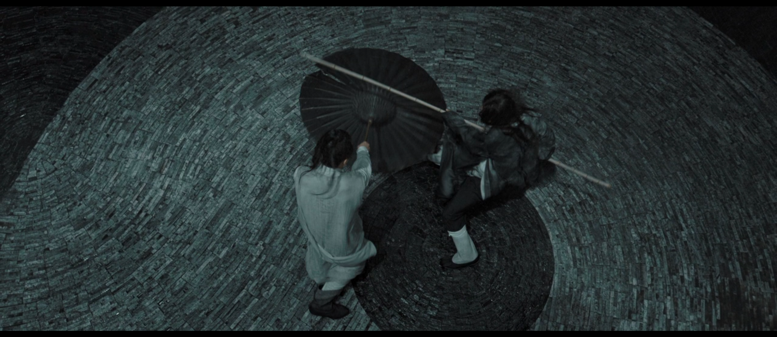
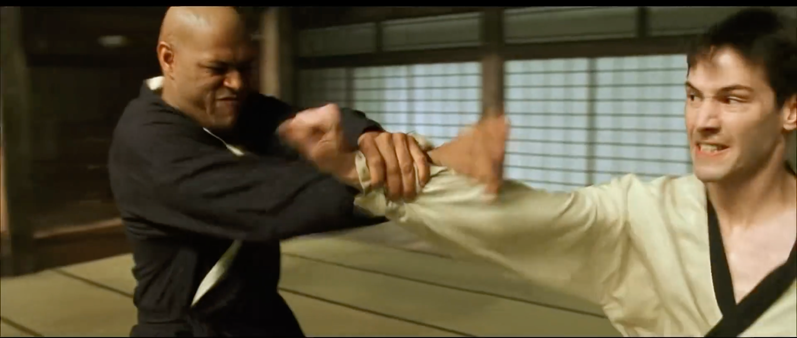
Here we see some more aspects of character revealed. Zi Yu named his shadow Jingzhou after the city he was born in – to always remind himself of his cause. Zi Yu is always telling the shadow what his purpose in life is, while at the same time he’s trying to find out who he really is. This is the hallmark of every great character – the world is trying to define you while at the same time you’re trying to define yourself.
Somehow, it’s getting clearer through every scene that this is becoming more of the shadow’s story and about his growth to become a whole human again.
Value: - This scene ends in a negative since Zi Yu and the shadow haven’t found a way to defeat Yang Cang.
Scene 11: 36:02 - 41:19: Plot summary - Lu arrives to tell the King that he told the Yan’s about the marriage proposal. +
Qing Ping has no idea that her Brother has made this arrangement and refuses to marry Yang Cang’s son Yang Ping. -
To make matters even more complicated the King of Yan has offered his own daughter to marry Yang Ping, which Yang Ping accepted. –
Yang Ping has offered Qing Ping to be his concubine. It’s a slap in the face to the King and the Pei court. --
Yang Ping has offered his personal dagger to Qing Ping if she accepts. The General and his officers want to wage war on the Yan’s. -
The King refuses to start a war. +
The General steps down from his position and is almost murdered by the king (-) but Qing Ping stands in their way and stops her brother. She accepts the marriage in order to cool down the situation. +
Comments: It’s interesting to note how the writers begin to use the old technique of “plant and payoff” with objects in this film. The dagger that Yang Ping has offered Qing Ping is planted and the payoff will come later on in the film when she murders him with it.
We see this scene’s main focus is the Qing Ping and Yang Ping subplot. Qing Ping sees what kind of man her brother really is. This is important because she will defy him later on when she joins the army that attacks Jingzhou. Also, we haven’t even seen Yang Ping but we know he’s a pretty devious guy. Offering to take on the princess as a concubine is worse than being called a whore and so just by hearsay we get a glimpse into his character.
The scene begins with the King’s painting his “ode to peace” – a sign of maintaining order. Later on, in the scene the order is attacked when the general kicks one of the “ode to peace” paintings. A symbol that the order needs to be broken and that they need to go to war. This constant pushback from characters makes the King one step closer to losing his power.
This scene is interesting because it shows how desperate the King is to prevent a war. Even his own court is rebelling against him because of the disrespect shown to them by the Yan’s and the King’s willingness to just stand by and let them dishonor their name.
Certain actions have immense power in this scene. For example, when the General stabs himself with the arrow. What kind of person does that? Someone with nothing to lose. The General, a symbol of the head of an army, is now in defiance of his King. These small actions communicate shifts of power to the audience without them ever realizing it.
Value: + Even though things are crumbling I’m going to say this scene ends on a positive note since the King is pretty confident there’ll be no war.
Scene 12: 41:20 – 44:07: Plot summary - Yang Cang and Yang Ping, true warriors practice against each other. Yang Cang is confused that Zi Yu was in perfect health after giving him such a big wound. He tells his son that he offended the Pei court after offering Qing Ping to be his concubine. –
Arrogant, Yang Ping wanted to send a signal to the court but it backfires after his Father tells him they’ve accepted his offer. -
Yang Ping shrugs it off after realizing the Pei kingdom is falling apart and that their spy will give them any updates. +
Cang tells his son to keep 800 troops in Jingzhou for the attack since he’s unbeatable. +
Comments – For the first time we leave the Pei court and we get a glimpse into the Yang family. What do we discover about them? They’re multi-generational fighters who say they’re unbeatable, which means they’re very confident and maybe even arrogant. They represent the male energies.
Yang Cang is presented as one of those mythical heroes from a fantasy novel, while his son is quite childish. It seems without his Father Yang Ping would be nothing.
Value: + The Yang’s are very confident they’ll win both the duel and the war. The next scene will show the opposite. Again, perfect timing.
Scene 13: 44:08 - 48:54: Plot summary - Xiao Ai mentions how Yang Cang’s moves are similar to fire which is Yang. Yin counters Yang. Water puts out fire. Therefore, to defeat Yang Cang the shadow needs to harness Yin, the feminine aspects.
Xiao Ai shows her move to Zi Yu who sees potential. He tells Xiao Ai to guide the shadow through the moves. The shadow and Xiao Ai become one and the move works. Now they know how to defeat Yang Cang.
Comments: This is a brilliant use of killing two birds with one stone. The writers have connected the idea of training the shadow along with the romantic sub-plot between Xiao Ai and the shadow. It’s obvious in this scene that Xiao Ai and the shadow discover they’re in love with each other. They just haven’t verbalized it yet but they both know. In a couple of scenes, the deal will be sealed.
Value: + This scene moves the shadow and Zi Yu one step closer to defeating Yang Cang.
Scene 14: 48:54 – 50:25: Plot summary - The shadow meets the General in the forest and says he has 100 of the toughest criminals who need to be trained in order to take over Jingzhou. Now the General and the shadow create their own army of mercenaries behind the King’s back. The shadow says Zi Yu wants to see him.
Value: + This is good news for Zi Yu and the shadow. They’re getting one step closer to defeating the Yang’s and taking over Jingzhou.
Scene 15: 50:25 – 55:00 – Plot summary: Like a phantom from the past the General meets Zi Yu and says he will be his leader forever. +
Zi Yu confides to the General that he found a way to defeat Yang Cang but he knows the King knows about his shadow. +/-
In order to get Jingzhou back he needs 1. The shadow 2. The general. 3. The King.
Comments: This is the mid-point of the film and the last scene of Act 2A when a new twist is introduced. In a turn of events Zi Yu not only wants to defeat Yang Cang and take over Jingzhou but he wants to be king. This new idea will be the main driving force in the 3rd act but things will get even more complicated later on.
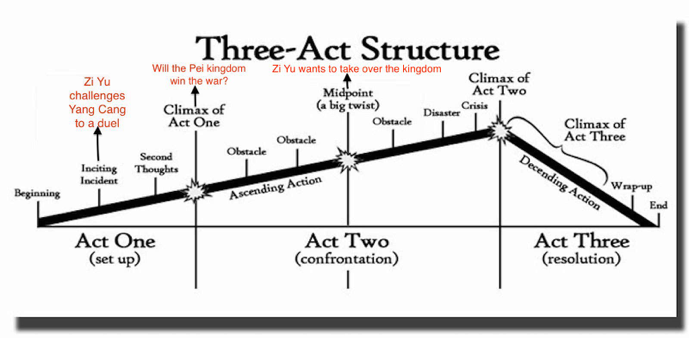
The audience is seeing a dark side to Zi Yu they haven’t seen before and this is shown in the last shot of the scene:
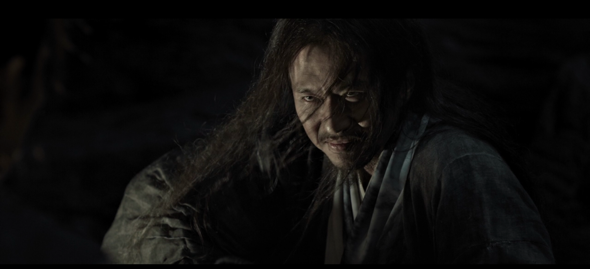
He’s fully turned into the shadow of the man he once was since he’s filled with hate and rage. I think at this point Zi Yu shifts from being one of the protagonists along with the shadow to becoming another antagonist along with the king.
Protagonist: Shadow
Antagonist: Zi Yu and King
This switch is also a switch in the narrative since our main hero is now going to be the shadow. It’s a swapping of good and bad, which is rarely done in Hollywood. One of the few films that employs this technique is “Training Day”, where the mentor becomes the antagonist.
Value: - It’s now a negative since Zi Yu, now the antagonist, is executing his plan perfectly.
Scene 16 55:00 – 57:34: Plot summary - The King tells his sister that soon they will go into battle. –
She needs to trust him because his plan to marry her off as a concubine is just a decoy. What’s real then? She asks. The king isn’t sure anymore. --
Comments: Here we gain more of an insight into how the King thinks. He’s willing to deceive his sister in order to maintain his crown. Both of them don’t even know what’s real or what’s fake anymore.
Value: -- Double negative. The king failed in preventing war and is losing his relationship with his sister. He’s also losing a grip on reality and who’s winning the chess game.
Scene 17: 59:07 – 1:05:12: Plot Summary - The shadow confides to Xiao Ai that he’s only stayed in the court for her. He had many opportunities to run away but stayed for her. +
Later, they kiss each other but Zi Yu watches the whole thing play out. --
Comments: This scene is important because finally we realize the shadows true feelings towards Xiao. This is a double positive for the Xiao Ai and shadow subplot. This deep love for Xiao Ai is the first time he truly feels himself and that he’s made the most important decision of his life. This is a big part of the shadow’s psychological makeup to being a whole human.
However, when Zi Yu sees the shadow kissing his wife he feels betrayed and jealous. This adds a complication before the war that will change the shadows life in the future.
Value: - I think it ends negative since Zi Yu’s fears are confirmed. By him witnessing his wife and the shadow making out he’s going to try and get rid of his shadow – but only when he’s killed Yang Cang and taken over Jingzhou.
Scene 18: 1:05:12 – 1:18:52: Plot summary - Yang Cang is told Zi Yu has showed up alone on a boat. Is it a trick? Yang doesn’t think so. He goes on to fight against Zi Yu. +
Inside the boat – it’s filled with the 100 soldiers who dive into the water to attack. One of them turns out to be the princess. -
They attack the village and an all-out war ensues. The princess kills Yang Ping with his own dagger but she dies in the process.
Comments: We have three battles going on in this scene. 1. The shadow fighting against Yang Cang. 2. The general and his small army going at it with the Yan kingdom (in one of the coolest filmed scenes with the umbrellas). 3. Qing Ping and Yang Ping fighting in their small battle.
The fight with Yang Cang and the shadow is the “All is Lost” moment of the film. It looks like Yang Cang is going to kill the shadow and the Pei’s are going to lose.
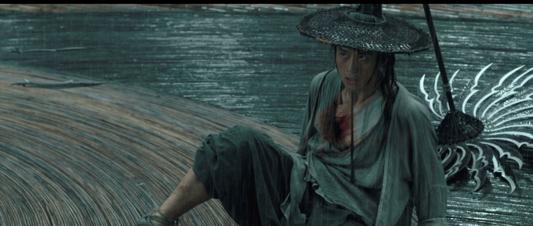
This moment is a very standard moment in all films – most especially in action films. We think the hero will be defeated and this is simply to put the audience on the edge of their seat. The writers leave us hanging with what will happen until two scenes later.
This is also the end of the Qing Ping and Yang Ping subplot. They both ended up dead in a twist of fate. Qing Ping sacrificed herself in order to end Yang Ping’s arrogance. What does this say about morality in the film? That a bad deed will be punished with death. Qing Ping and Yang Ping’s deaths foreshadow what’s going to happen in the 3rd act climax.
The other function of Qing Ping’s death is that it will add to the psychology of the king in the 3rd act. This is what he tried to prevent. He used his sister as a tool and now he only has himself to blame. This sense of “not having to lose anything” will definitely come into play later on. Again, the writers are pushing these characters to the nth degree and they’re building up the energy to be released at the climax of the 3rd act.
Value: -- Double negative. It looks like Yang Cang will win and that the Yang army will overrun the Pei soldiers.
Scene 19: 1:18:52 – 1:23:46: Plot summary - Xiao Ai discovers the hidden compartment where Zi Yu could spy on them. She assumes he saw her and the shadow kissing.
The two of them play the 古筝 (zither) and through their frustrations they make music.
The general announces the city of Jing has been take over. The shadow kills Yang Cang.
Comments: The Pei kingdom has won the war. The hero has killed Yang. Traditionally this would be the 3rd act climax in a Hollywood film but in Shadow it’s the end of the 2nd act. Why?
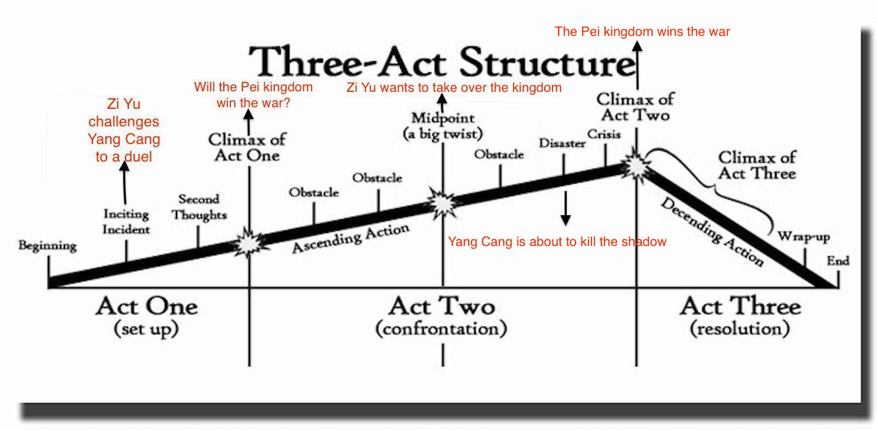
This is a film about the clashing of destinies and about becoming who you were always meant to be. What will become of the shadows fate? What about the fate of the King? And Zi Yu? Things are still unsettled between them and so the 3rd act will be about two things:
1. Zi Yu wants to be king and the king wants to maintain his power. What will the outcome be?
2. The shadow needs to become his own person. How does his journey mix into fate of Zi Yu’s and the king?
But before we get there the writers need to add some flavor to the mix and they need another tragic event in the shadows life to change him and most importantly pull him into Zi Yu and the kings problem. This is the function of the next scene and it’ll change their destinies forever.
Value: ++ It ends on a double positive note. Yang Cang is dead and the Pei’s won the war.
Scene 20: 1:23:46 – 1:27:03: Plot summary - The shadow, believing he’s free, goes to visit his Mom but he finds her dead. --
After he’s attacked by some random soldiers, luckily his life is saved by a nameless man who’s been sent by the king. ++
Comments: Another twist in the dramatic triangle between the Shadow, Zi Yu and the King. The audience can infer that Zi Yu has betrayed the shadow for stealing his wife’s heart. However, the King knew about this and intervened on the shadow’s behalf. Now the shadow knows the king is really on his side. Or does he? The function of this scene is to sow doubt in the shadow’s mind about what happened.
Value: ++ This scene ends with a double positive. Yes, his mom died previously but his life was saved. That’s the most important value in a film – staying alive.
Scene 21: 1:27:03 – 1:28:17: Plot summary - The King discovers his sisters body and Yang Ping’s dagger that she was killed with. -
Comment: The King’s biggest fear has been realized – his sister is dead. He’s been trying to prevent a battle for the whole film so things like this wouldn’t happen but the destiny of the other characters overpowered his destiny. He’s lost total control of his kingdom and now he’s a man who’s got nothing to lose. Aren’t those the worst people to fight against?
Value: - The scene ends on a negative.
Scene 22: 1:28:17 – 1:47:56: Plot summary - The king announces to his court that the great Commander is on his way. Xiao Ai has no idea which person he’s talking about.
The King’s soldiers attack the real Zi Yu. -
The shadow makes it back to the court and they all celebrate. +
Lu is murdered by the King after being outed as the spy for Yang Cang. -
The King admits he knows about the real identity of the shadow but praises him for taking back Jingzhou. He wants the shadow and Xiao Ai to be together forever. +
A soldier walks in carrying a box, which the king thinks is the head of Zi Yu. When the king opens the box and it’s empty, the soldier who’s actually Zi Yu, stabs the king and kills him. -
Zi Yu says he was framed for killing the shadows mother and wants the shadow to be with Xiao Ai. Zi Yu wants the shadow to kill the king but instead he kills Zi Yu. +
The shadow puts a mask on Zi Yu and says “without the real there is still a shadow”. A POV shot shows the shadow on the left eye and Xiao Ai and the shadow kissing on the right eye.
The shadow ends the king’s life and puts the sword in Zi Yu’s hand to make it look like Zi Yu killed the king.
The shadow gives Xiao Ai the medicine she gave him a long time ago.
The shadow makes an announcement to the kingdom that an assassin has killed the king and he killed the assassin. +
The last shot of the film is the opening shot. Xiao Ai looks like she fears for her life.
Comments: Wow, take another deep breath. This scene is nearly 20 minutes long and is written and directing masterfully. It’s similar to a back and forth dance, a push and pull of shifting energies that we’ve seen repeated over (think when Xiao Ai and Zi Yu fight with the spear and umbrella, and when the shadow fights Yang Cang).
Let’s break this down in detail:
The killing of Lu is actually the last moment of the Qing Ping and Yang Ping subplot. The writers felt it necessary to add this element where Lu, who was the spy for the Yang’s, is actually the one who made the offer to the king for his sister to be Yang Ping’s concubine. This isn’t really necessary in all honesty but it’s closure for the king. I don’t think the audience would even remember Lu at this point but it sets the stage for the bloodshed that will ensue throughout the scene.
Then the king admits to the shadow that he knows of his real identity and wants the shadow and Xiao Ai to become a real couple. The suspense of the scene is brilliant since the king points his sword at the couple constantly. At this point we know the king is off the rails and at any moment can kill the shadow and Xiao Ai. The king then offers the shadow to be his commander and for both of them to rule the kingdom. This sounds a bit like Darth Vader asking Luke to join him on his conquest. The shadow, having seen who the king really is, would never agree to that. Just before the shadow gives his answer Zi Yu walks into the room. Again, the timing is so well done in this film. To just constantly leave the audience hanging to know more is a brilliant tool to just keep reel in our attention.
I think the moment where Zi Yu kills the King is quite predictable. At this point Zi Yu is mad with excitement that he’s carried out his plan and has won the chess match subplot. In a small twist, Zi Yu says that the king tried to frame him for killing the shadow’s mom but the shadow isn’t buying it. In order for the shadow to become a whole man he needs to get rid of the man who’s been holding him back his whole life - Zi Yu and he does exactly that.
There’s a moment where the shadow puts a piece of a mask onto Zi Yu’s helmet. I can only speculate what this moment means but only in death can Zi Yu be whole again. In life he would always be a shadow of himself. Hiding in a cave and scheming his whole life away is not what balance means.
Then there’s a POV shot from Zi Yu’s perspective with the shadow in his left eye and the scene of the shadow and Xiao Ai making love on the right eye. What does this mean? Again, I can only speculate but we can guess that Zi Yu did kill the shadow’s mom out of jealousy for what he saw. This image of Xiao Ai and the shadow making love must have driven Zi Yu out of his mind and it consumed his whole being.
In order to make it look like an assassination, the shadow stabs the king and puts the blade in Zi Yu’s hand. Very smart indeed. The end of a chess match ends in blood. Two opposing forces cancel each other out and the shadow is the new product. Thesis, antithesis and synthesis. The shadow is fully his own man. This is the 3rd act climax.
The next moment is when the shadow hands Xiao Ai the bag of medicine. This is just a guess but from all the bloodshed she’s witnessed from the shadow that evening, this is a gesture to remind her of who he really was. He wants her to remember that night and the goodness that he has in his heart. This might influence her in her hard decision.
The last shot of the film, which is the beginning scene, where we’re told “Xiao Ai will have to make the hardest decision of her life”. We now know what the decision will be: will she go along with the shadow’s lie or does she tell the truth? The writers leave us with an open ending that can be interpreted in so many ways and each one of them is valid.
1. If this story is about becoming who we were truly meant to be, we can infer that maybe she will betray the shadow and out him. Isn’t that the authentic thing to do? It depends on if she psychologically has split apart from Zi Yu or not.
2. This final shot also references the same shot when Zi Yu was spying on Xiao Ai and the shadow kissing from his hidden cave. Only now Xiao Ai is playing Zi Yu’s role as manipulator and now she’s the one trapped within herself. Will she manipulate the shadow like Zi Yu manipulated the shadow?
Let’s say, hypothetically speaking, that if this scene were to continue what do you think Xiao Ai would do? You can send your comments to me.
Value: ++ The shadow is alive and he will probably become king. He also has Xiao Ai in the end. After much bloodshed and loss, he finally became his own distinct being (a fully formed ego).
Conclusion: This film uses a traditional 3-act structure. The only variation is:
1. The switching of the antagonists/protagonist halfway through the film.
2. The 2nd act climax, where the Pei’s win the war, in a Hollywood film is typically the 3rd act climax. This is simply because the destiny of the characters in this film is more important than the plot.
So, as we can see the structure isn’t so different from a Hollywood film and there’s nothing mysterious about it. One of the reasons why I consider it to be such a high level of storytelling is it’s so tightly designed and there’s not a scene or a bit of dialogue that goes wasted. The writers did an incredible job overall and I can’t imagine the work that went into designing it.
One interesting thing to note is the balance of the film. The first half is plot heavy and there’s a lot of drama going on between the characters. The second half however, has a large emphasis on action and feels a lot lighter in terms of plot. This is a bit of a gamble since audiences are typically accustomed to seeing more action near the beginning but I think if the viewer is patient it’ll pay off.
Lastly, from the shadows perspective there are more elements of a comedy since it ends ++. From Zi Yu’s perspective it’s a tragedy since he ends the story in a double negative. Since the film ends on a more positive note the writers are saying something deep about life – when we confront and overcome the darker sides to our natures and embrace the light only then will we become a fully formed person.